One Number Killed the Sears Catalog. It Wasn't Sales.
Playing the video loads YouTube. Watch on YouTube instead.
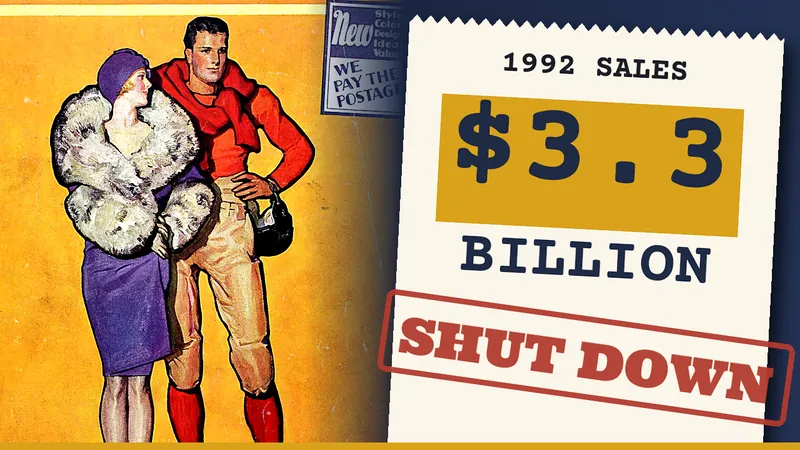
In 1992, one book still sold about $3.3 billion worth of everything — guitars, work boots, refrigerators, Christmas toys. A year later, the company that printed it shut it down for good. It wasn't killed by a lack of customers. It was killed by one number.
This is what happened to the Sears catalog: how a Chicago watch seller built the "Big Book," how Americans ordered whole houses by mail, and the ledger math that ended it in 1993.
Chapters in the video
The story, in writing
In 1992, one book still sold about $3.3 billion worth of everything. Guitars, work boots, refrigerators, Christmas toys. A year later, the company that printed it shut it down for good. It wasn't killed by a lack of customers. It was killed by one number, and we'll get to it.
For almost a century, it sat next to the family Bible in American homes. This is what happened to the Sears catalog.
How the Catalog Worked
Picture a farm in the 1890s. The nearest real store might be a day's ride away, and the general store in town charges whatever it likes. Then the mail carrier brings a book. Inside are watches, sewing machines, bicycles, buggies, saddles, even eyeglasses with a test you could take at the kitchen table.
It started small. In the late 1880s, a railroad station agent in Minnesota named Richard Sears began selling watches by mail. By 1893 the company was called Sears, Roebuck and Company, and by 1894 the cover was calling itself "The Cheapest Supply House on Earth."
Richard Sears wrote much of the copy himself, in plain, country language. He wanted a farmer to feel that the man selling the plow understood the farmer.
He also made promises a stranger at a distance had to make. By 1903, the catalog said it plainly: your money back if you are not satisfied. Sears even hired translators who could, as the company boasted, read and write all languages, so an order scrawled in German or Swedish or Polish would still get filled. For a family that had never seen the warehouse, that guarantee was the whole deal.
And the book kept growing. The 1897 edition ran 786 pages, and that was the year color first appeared, in a section of shoes in black, brown and red.
The year before, Sears had already made the book physically bigger, from about six by nine inches to eight by 11, and started printing a spring and a fall edition. Groceries showed up in it. So did hand-cranked washing machines and the Encyclopaedia Britannica. It was turning into a department store you could hold in your lap.
Sears even charged for the catalog for a while, starting in 1896. A quarter, which he promised to credit against any order over $10. Copies went out by the hundreds of thousands, and then by the millions. By the fall of 1908, a single edition went out in more than 3.5 million copies.
Washington helped, too. The post office carried catalogs at cheap rates, Rural Free Delivery brought mail to farm doors, and in 1913 Parcel Post started carrying the packages. The catalog was the high technology of its day: printed in Chicago, delivered by the government, and paid for with a money order.
And it didn't stop at boots and bicycles. By 1908, you could order something much bigger out of a Sears book. We'll come back to that, because it's the most surprising receipt in this story.
The Money: a house and a guitar by mail
Here's the thing people forget. Sears didn't just sell a house plan. Starting in 1908, it sold the house: lumber cut to size, nails, shingles, doors, paint, everything shipped by rail in numbered pieces, with a book of instructions. You supplied the land and the labor.
Take one model from the 1921 catalog, called "The Honor." Nine rooms, four bedrooms, a sun room downstairs and a sleeping porch above it.
$2,747. In today's money, that's about 52,000. Not including the lot, the foundation, or the weekends your family spent hammering. Still, for a nine-room house, that is a remarkable receipt. Sears sold tens of thousands of these kit homes before the program ended in 1940, and many are still standing.
But the everyday heart of the catalog was smaller things, the ones a kid circled in pencil. Jump ahead to the fall of 1963. On one page sits a guitar from Sears' own Silvertone brand, and the case it comes in has a tiny tube amplifier built into it. Plug in, and you're a rock band.
$68. About 750 of today's dollars, or roughly 54 hours at the minimum wage. That's well over a week of work for a first electric guitar. A lot of famous musicians started on exactly this kind of cheap catalog guitar. And someone was making money all along that chain: the factories building to Sears' specs, the printers in Chicago, the railroads, and above all, Sears.
So by the 1960s and '70s, this thing was enormous. It was printed in the millions, the mail-order arm of America's biggest retailer. Which makes what came next even stranger.
The Number That Killed the Big Book
The first crack came from Sears itself. In 1925, the company opened its first retail store in Chicago. Then dozens more, then hundreds, out where the new car owners lived. Each new store gave customers one less reason to wait for the mail.
For a while, the two lived side by side. In 1933 Sears added a separate Christmas catalog, and in 1968 the words "Wish Book" first appeared on its cover. For a lot of kids, that's the version they remember: the toy pages, dog-eared by Thanksgiving. But the money was quietly shifting from the mailbox to the parking lot.
Meanwhile America moved to town. The farm families who had been the catalog's best customers became a smaller and smaller share of the country, and city shoppers had department stores, then malls, a short drive away.
Then, in the 1980s, the catalog business itself changed shape. Smaller companies figured out they didn't need a book with everything in it. They needed a slim, glossy book for exactly the right person. Lands' End for sweaters. Eddie Bauer for the outdoors. Lillian Vernon for gifts. Even Sears' big rivals, Spiegel and J.C. Penney, started mailing smaller, targeted catalogs.
Sears tried. It split the catalog into separate books for clothing and for hardware in 1985, added a toll-free number in 1989, and put a famous model on the cover. But the core idea stayed the same. One giant book, mailed to everyone.
And here's the number we promised you at the start. Printing a book the size of a phone directory and mailing it to millions of homes costs a fortune, whether or not anyone orders. By the early nineties, the catalog was losing somewhere between 135 and 175 million dollars a year, after taxes, even while it sold 3.3 billion.
It wasn't that people had stopped ordering. Millions of Americans still bought from the book every year. And Americans hadn't fallen out of love with mail order either; more of them were shopping by catalog than in the mid-eighties. It was the model that broke. Reaching everyone with everything had become the most expensive way to sell anything.
On January 25, 1993, Sears made it official. The big book would end after the spring edition. Along with it went 113 stores, about 2,000 small catalog stores, most of them independently owned, and 50,000 jobs. The executive in charge, Arthur Martinez, called it the most difficult of all the decisions, because, in his words, "It is Sears."
It cost money to stop, too. Sears booked a charge of about $1.7 billion, after taxes, to pay for the whole restructuring. Painful, but the company expected the cuts to save it roughly 300 million dollars a year.
The phones stayed open into the spring. Then, on May 27, 1993, Sears took its last telephone order from the big book. Customers had rushed to buy so fast that the warehouses were nearly empty, and most orders from that last book, well over a thousand pages thick, could no longer be filled.
What's Left
The big book died, but the idea didn't, not entirely. Sears kept printing smaller specialty catalogs, and it brought back a slimmer Christmas Wish Book in 2007.
The stores had a harder road. As of late 2025, only five Sears stores were left in the whole country. The website is still there.
Some pieces of the catalog are still physically with us. In Chicago, the old Sears tower that rose over the catalog plant still stands. And all over the country there are kit houses that arrived by rail a century ago, with families living in them who may not even know their house was once a page in a book.
The catalog had spent a century making things cheaper and cheaper to buy. In the end, it couldn't make itself cheap enough to deliver.
The Lesson
Maybe that's the lesson tucked inside this old book. The thing that makes you indispensable to one generation can become the thing you can't afford to keep for the next. The Sears catalog brought the city to the farmhouse. It just couldn't follow those farmhouse kids to everywhere they went next.
Adapted from the episode's narration. Numbers are explained in the video and listed with their sources below.
Free · Twice a week
Liked this one? Get the next receipt.
One short email when a new episode is out, with the sources. No spam. Unsubscribe any time.
Sources
LEDGER CHECKS
Prices converted to 2026 dollars with the BLS CPI-U (Sep 2026). Hours of work use the federal minimum wage of the period.
SOURCES & ARCHIVE MATERIAL
Archive film (Internet Archive / Prelinger Archives, public domain):
Henry Browne, Farmer (1942) · Our Home Town: Levittown, Pa. (1954) · Shopping Can Be Fun (1957) · Printing (1947) · Town and the Telephone (1950) · Freedom Highway (1956) · Poverty in Rural America (1965) · Nation at Your Fingertips (1951) · Operator Toll Dialing (1949) · Television commercials: Telephone (1970) · Mail: A Story of the United States Postal Service · American Fashion and Department Stores (Parts I-II) · Dollar Store · Quality Control in Modern Merchandising
Catalog scans (Internet Archive, public domain): Sears, Roebuck & Co. catalogs 1897, 1911, 1922, Fall-Winter 1929-30; Honor Bilt Modern Homes (1921); A Visit to Sears, Roebuck and Co. (1914)
Photos: Wikimedia Commons (public domain / no known restrictions), including U.S. National Archives EPA DOCUMERICA photographs (1970s), Smithsonian/USPS Flickr Commons, HABS/Library of Congress
Music (public domain / CC0 recordings via Wikimedia Commons): Scott Joplin — Elite Syncopations, The Entertainer, Reflection Rag; Erik Satie — Gnossienne No. 3, Gymnopédie No. 1; Edvard Grieg — The Death of Åse (Musopen Symphony); Frédéric Chopin — Nocturne Op. 55 No. 1
Sound effects: Wikimedia Commons (public domain / CC0)
Cash register sound: "Cash register.ogg" via Wikimedia Commons (public domain), commons.wikimedia.org/wiki/File:Cash_register.ogg
Research: Sears Archives (catalog and Modern Homes chronologies); The New York Times, Los Angeles Times and Washington Post (Jan 26, 1993); Christian Science Monitor (Jan 28, 1993); Roanoke Times (May 28, 1993); U.S. Bureau of Labor Statistics CPI-U; U.S. Department of Labor minimum-wage history; USDA farm population data.
Some visuals are illustrations and are labeled "ILLUSTRATION" on screen.